

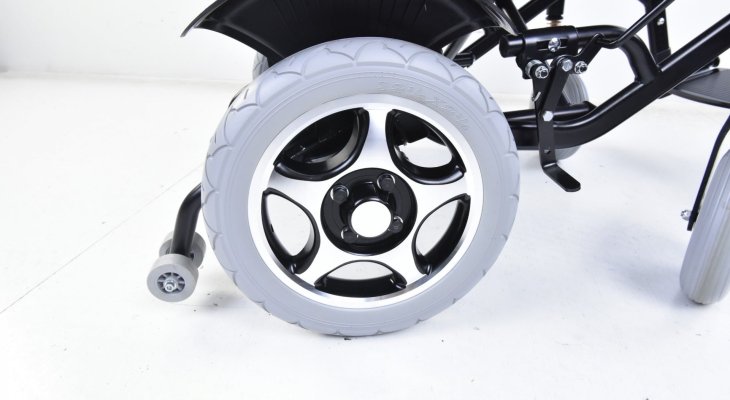
Technical Comparison of Solid, Pneumatic, PU and Suspension Systems
The wheel structure plays a major role in the performance of a powered wheelchair. The wheel material, ground compatibility, and vibration level directly determine driving quality. Therefore, wheelchair wheel technology is at the center of safety and comfort. Below is a technical overview of different wheel types, suspension systems, and surface behavior.
Solid tires provide long-lasting use since they carry no risk of puncture or blowout. As they contain no air, there is no pressure loss. This durable structure is a major advantage, especially for users who frequently travel outdoors.
However, solid tires may transmit more vibration. Wheelchairs with suspension frames significantly reduce this issue, balancing durability and comfort.
Pneumatic tires significantly reduce vibration thanks to their adaptive structure. Internal pressure absorbs shocks and provides smoother driving on uneven surfaces. Air support also reduces rolling resistance, increasing range.
They require regular pressure checks, and although puncture risk is low, it is not eliminated. When properly inflated, pneumatic tires become one of the most comfortable options.
PU (polyurethane) tires combine durability and comfort. Their internal structure resists punctures while surface flexibility provides smoother driving. This balance makes PU tires popular among users.
They also require no maintenance and dampen vibration much better than solid tires.
No matter how advanced wheel technology is, vibration cannot be fully controlled without suspension support. Suspension is therefore an integral part of wheel performance.
Advantages of suspension systems:
Effectively reduce vibration
Balance the hardness of solid tires
Improve control on uneven terrain
Increase maneuver stability
Dual-suspension models provide major benefits, especially for outdoor use.
Wheel size directly affects driving physics. Larger diameter improves obstacle clearance and ramp performance. Wider tires increase grip on slippery or soft surfaces.
Correct sizing significantly impacts obstacle crossing, acceleration, braking, and stability.
Wheel selection must match the terrain. Each tire behaves differently.
Parquet / Smooth Floor: Solid or PU
Carpet: PU or Pneumatic
Rough Pavement: Pneumatic + Suspension
Grass / Sand / Soil: Wide-base Pneumatic
This matching increases both comfort and safety.
Range is not only determined by battery capacity. Wheel material also affects motor load. Solid tires increase rolling resistance and energy consumption.
Pneumatic tires adapt to the surface and reduce energy use. PU tires provide balanced performance between both.
The user’s center of gravity directly affects wheel performance. When weight shifts forward, front wheels bear more load and maneuverability decreases. When shifted backward, downhill control weakens.
Correct cushion, back angle, and seating position are as important as wheel-ground compatibility.
Outdoor Users: PU or Pneumatic
Comfort Priority: Pneumatic
Low Maintenance Preference: Solid
Vibration-Sensitive Users: PU
Rough Terrain: Wide Pneumatic
Correct selection significantly improves the user experience.
All the above shows that powered wheelchair wheel technology is central to driving quality. Solid, pneumatic, and PU tires serve different needs, while suspension systems elevate performance. Correct wheel selection greatly improves safety, comfort, and range.
Copyright © 2026 AdresGezgini. All rights reserved.