

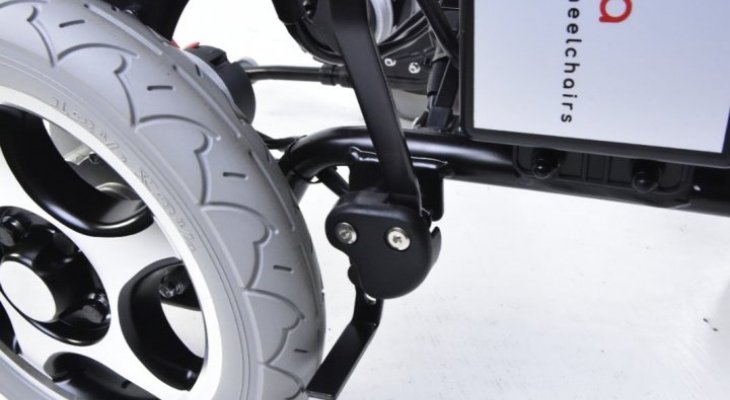
Safety is one of the top priorities for powered wheelchair users. Maintaining control during ramps, elevator entrances, and narrow door passages is vital. At this point, the powered wheelchair braking system protects the user continuously. In addition, electromagnetic brake (EMB) technology is the core structure that increases reliability in modern wheelchairs.
In this article, I explain technically how electromagnetic brakes work, detailing torque lock logic, grip behavior on inclined surfaces, and PG VR2 + Kensa motor compatibility. This helps clearly understand why braking systems are so critical.
An electromagnetic brake is an advanced braking structure connected to the motor shaft and controlled by electrical energy. When powered, the brake releases; when power is cut, the disc locks. Thus, when the wheelchair stops, the wheels remain fixed and rollback is prevented. Since no mechanical pads are required, maintenance needs are very low.
The system works through four main components:
Coil: Generates a magnetic field when electricity is applied.
Brake Disc: Moves freely under the magnetic field.
Spring Mechanism: Locks the brake when power is cut.
Motor Shaft Connection: Transfers braking force directly to the wheels.
This structure prevents unintended movement on both flat and inclined surfaces.
The EMB continuously communicates with the controller during driving. When the joystick moves forward, energy is sent to the brake coil and the brake releases. When the joystick returns to neutral, power is instantly cut, the spring locks the disc, and the wheelchair stops safely.
This process happens within milliseconds, ensuring stability during sudden stops.
Torque lock is one of the strongest safety advantages:
Prevents rollback on ramps
Reduces movement during transfer
Prevents wheel rotation even under external force
When power is cut, the disc locks instantly. Torque lock prevents sliding regardless of slope direction, ensuring the wheelchair remains stable on ramps.
The braking system is central to driving safety:
Provides full locking when stopped
Prevents slipping and sudden drift
Ensures control at doors and elevators
Maintains safe position on ramps
Brake performance depends on motor compatibility. Kensa motors use low-tolerance shaft design and wide brake discs for better response and stability.
Brake signal transmitted within milliseconds
Motor torque reset
Brake locks instantly
This prevents rollback, improves low-speed braking, and ensures stable sudden stops.
Activates automatically when power is cut
Low maintenance, long lifespan
Fast braking response
Compatible with motor controller
Stable even on rough terrain
Coil failure may prevent movement
Misalignment may cause vibration
Incompatible control may cause delay
With high-quality systems, these issues are eliminated.
High-density copper coil
Wide brake disc
High-flexibility spring
Low-tolerance shaft
Provides strong ramp grip, prevents rollback, and ensures stable stopping.
Coil quality, disc width, shaft alignment, spring strength, PG VR2 compatibility, torque lock power, ramp test results, full lock when power is cut.
Electromagnetic braking provides the highest safety in powered wheelchairs, ensuring stability, compatibility, and full user confidence.
Copyright © 2026 AdresGezgini. All rights reserved.